
Recent cyber attacks affecting some UK universities have once again highlighted the challenges facing the higher education sector. The incidents have reminded us all of the risks universities face when managing vast amounts of sensitive data across increasingly complex digital environments.
The University of Nottingham recently confirmed that hackers accessed its student records system, potentially exposing the personal and financial data of around 450,000 current and former students. Meanwhile, the University of Oxford disclosed a separate breach affecting its third-party CareerConnect platform, demonstrating how cyber risk extends beyond an institution’s own network to its wider digital ecosystem.
These incidents reinforce the importance of universities protecting student and staff information, supporting world-class research, enabling hybrid learning and keeping thousands of users connected every day. As cyber threats adapt, IT leaders are under growing pressure to ensure their infrastructure is not only reliable but resilient.
Why Universities Are Being Targeted
Higher education institutions face a unique set of cyber challenges. With thousands of students, staff, researchers and visitors accessing systems every day, universities operate complex digital environments that need to balance openness with security.
The National Cyber Security Centre (NCSC) highlights that universities are attractive targets due to the valuable data they hold, the importance of their research and the complexity of their interconnected systems. This combination creates a challenging environment where maintaining strong cyber resilience is becoming increasingly important. The impact of an attack can extend far beyond data exposure. Universities may face disruption to teaching, research projects, enrolment systems and essential student services, while also facing potential reputational damage.
Cybersecurity Starts with Strong Foundations
Cybersecurity isn’t delivered through a single product or technology. It requires a layered approach that combines people, processes and technology.
One of the most important foundations is the network itself. A modern network provides the visibility, performance and resilience needed to support wider cybersecurity initiatives. When infrastructure is outdated or difficult to manage, IT teams have less insight into what’s happening across the environment, making it harder to detect issues, manage devices and respond quickly to incidents.
Modern network infrastructure can help universities:
- Improve visibility across connected devices and users
- Increase network resilience and reduce downtime
- Simplify management across campus
- Support secure access for students, staff and guests
- Provide a scalable platform for future digital initiatives
A modern, resilient network creates a stronger foundation that supports an organisation’s overall security posture.
A Real-World Example: The University of Buckingham
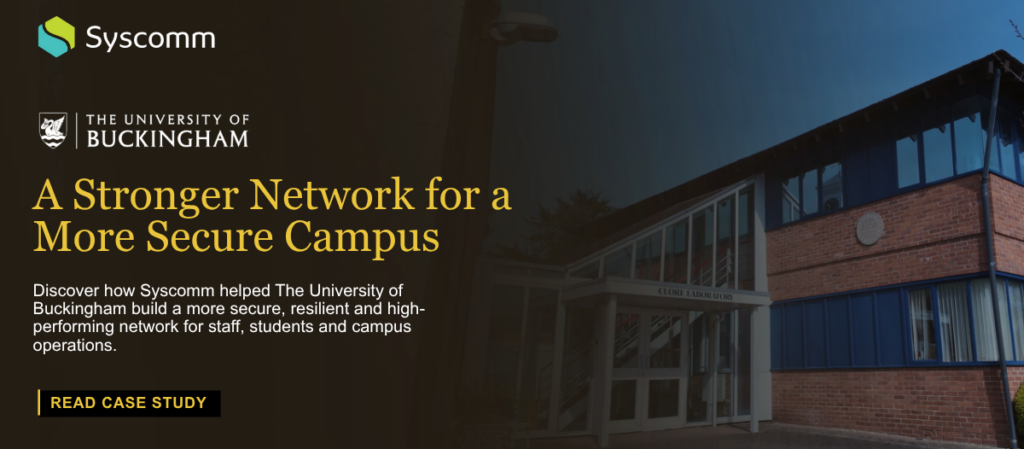
At Syscomm, we’ve seen first-hand the difference modern infrastructure can make. We recently partnered with The University of Buckingham; their campus is spread across a mix of historic and listed buildings, many of which were never designed for modern network infrastructure. Over time, the university’s network had grown organically to support this complex environment. While the infrastructure had served the university well, much of the hardware was approaching end-of-life, and the complexity of the environment made consistent management and maintenance increasingly challenging for the IT team.
Working closely with the university, we modernised the campus network to provide faster connectivity, improved reliability and simplified management. The project also reduced hardware requirements by around 25–30%, helping lower operational complexity while creating a platform capable of supporting future digital demands.
The result was a modern, resilient network infrastructure that not only improved performance across campus but also strengthened the university’s digital resilience, helping the IT team manage and support the environment with greater confidence.
Discover how Syscomm helped transform the University of Buckingham’s network by reading the full case study here: Campus Network Transformation: The University of Buckingham.
Looking Ahead
The recent wave of cyber attacks affecting UK universities serves as another reminder that digital resilience has never been more important. While there is no single solution to cybersecurity, investing in modern, well-managed infrastructure is an important step towards building a more secure and resilient campus. If your institution is reviewing its network strategy, our University of Buckingham case study demonstrates how the right technology and expertise can help create a stronger foundation for both operational performance and cybersecurity.