
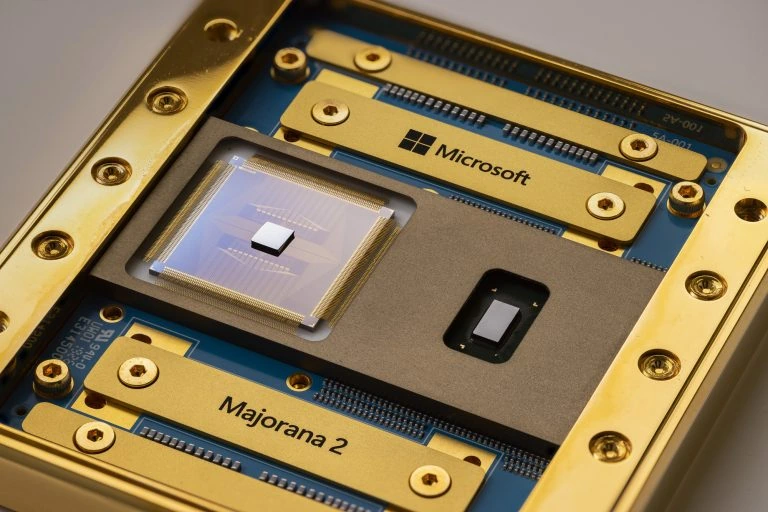
Majorana 2, Microsoft’s next-generation quantum chip (Photo by John Brecher)
Quantum computing has spent years feeling like a technology that is always just around the corner. On 2 June 2026, Microsoft took what it described as its most significant step yet, unveiling the Majorana 2 chip at its annual Build conference in San Francisco. The announcement generated considerable attention across the technology and cyber security industries, and for good reason. Microsoft claims Majorana 2 represents a 1,000-fold improvement in qubit stability over its predecessor and has cut its roadmap to a practical, scalable quantum computer from 2033 to 2029.
But Majorana 2 has also attracted significant scepticism from independent physicists, continuing a long-running scientific debate about whether Microsoft’s underlying approach has ever been properly demonstrated. So what exactly is Majorana 2, what has changed, and what should businesses make of it? At Syscomm, we help organisations understand how emerging technology developments affect their infrastructure and security strategy.
What Is Microsoft’s Majorana 2 Chip?
Majorana 2 is Microsoft’s second-generation topological quantum computing chip, announced at Microsoft Build 2026. It follows Majorana 1, which was introduced in February 2025 as the company’s first chip built on a topological approach to quantum computing. The core claim behind Majorana 2 is a dramatic improvement in qubit stability. Microsoft says qubits on the new chip have a mean lifetime of 20 seconds with some lasting as long as one minute. By comparison, Majorana 1’s qubit lifetimes were measured in milliseconds. The company describes this as being roughly 1,000 times more reliable, likening the improvement to a phone battery that lasts three years instead of a single day.
On the hardware side, the chip replaces the aluminium superconductor used in Majorana 1 with lead, and updates the semiconductor active region to a combination of indium arsenide and indium arsenide antimonide. The current chip is based on a four-qubit array, designed to expand over time as the technology matures. Microsoft’s quantum team says that based on this progress, they are now targeting a scalable, practical quantum computer by 2029, four years sooner than their previous estimate.
What Is Topological Quantum Computing and Why Is the Science Disputed?
Microsoft’s approach is built around a concept called topological quantum computing, using what are known as Majorana zero modes unusual quantum states that, in theory, would make qubits naturally more resistant to errors without constant correction. The idea is compelling. Rather than fighting environmental interference with continuous error correction, topological qubits would be inherently more stable.
However, the scientific community remains deeply divided over whether Microsoft has actually demonstrated the underlying effect. The scepticism has a long history. In 2018, a Microsoft-funded team published a paper in Nature claiming evidence of the key quantum effect. That paper was retracted in 2021 after investigators found that data had been selectively presented. A second related paper was retracted from Nature in 2022.
With Majorana 2, critics have highlighted that the new research presents only one of the two types of measurements, known as Z measurements, required to demonstrate a functioning qubit. Henry Legg, a quantum physics lecturer at the University of St Andrews, has stated that nothing in the presented data proves the existence of a topological qubit. Another prominent critic has said Microsoft’s quantum work has moved away from science and entered the realm of faith.
Microsoft has pushed back firmly. Executive vice president Jason Zander said the company stands behind its results 100 per cent and welcomes scientific debate. Microsoft has also stated that it has shared detailed findings confidentially with the US Defense Advanced Research Projects Agency and other government partners, even if full data cannot be released publicly.
The bottom line: the materials engineering progress reported with Majorana 2 is real and measurable. Whether Microsoft has demonstrated a true topological qubit remains one of the most contested questions in condensed-matter physics. No independent laboratory has yet publicly replicated its results.
Why Does Quantum Computing Matter for Businesses?
The importance of quantum computing is not that it will make everyday computers faster. Its potential comes from solving problems that are currently beyond the reach of even the world’s most powerful supercomputers. Microsoft is positioning Majorana 2 and its broader quantum roadmap around several specific sectors: materials science, chemistry, energy, healthcare and other complex scientific challenges. These are areas where traditional computing reaches hard limits. For enterprise technology teams, the near-term impact remains limited. Microsoft is not pitching Majorana 2 as a production-ready system for business workloads. The 2029 roadmap target is for a scalable, practical quantum computer that still represents three years of hardware and software development ahead.
For businesses thinking about their long-term technology strategy, our team at Syscomm can help you understand how emerging technology shifts affect your infrastructure planning.
Can Quantum Computers Break Encryption?
This remains the question that most concerns cyber security professionals and the Majorana 2 announcement makes it more relevant, not less. Modern encryption protects virtually everything businesses rely on: online banking, customer data, internal communications, cloud systems and more. Current encryption is considered secure because breaking it would require computational power far beyond any classical computer.
A sufficiently powerful, fault-tolerant quantum computer could eventually change that. Today’s quantum computers, including Majorana 2, are nowhere near capable of breaking modern encryption. But Microsoft’s 2029 roadmap is a signal that the timeline is compressing. The threat most worth planning for is what security professionals call “harvest now, decrypt later”. Attackers are already collecting and storing encrypted data today, intending to decrypt it once quantum computers become capable enough. This threat is active now, even though the decryption capability does not yet exist. For organisations holding sensitive data with a long lifespan: financial records, intellectual property, health information or personal customer data, this is not a future risk to defer. It is a present concern.
The National Cyber Security Centre (NCSC) has published detailed guidance on post-quantum cryptography that provides a practical starting point for organisations assessing their exposure.
Post-Quantum Cryptography: Why Businesses Should Start Preparing Now
The solution is already being standardised. Post-quantum cryptography (PQC) refers to encryption algorithms designed to resist attacks from future quantum computers, including the fault-tolerant systems that companies like Microsoft are working towards. In 2024, the National Institute of Standards and Technology (NIST) published the first finalised post-quantum encryption standards, giving organisations a concrete framework to begin planning their transition.
With Microsoft now targeting 2029 for a practical quantum computer, organisations that have not begun this planning are already behind where they should be. Replacing encryption across a large organisation takes years, it is embedded deeply in applications, devices, supplier relationships and infrastructure.
The organisations that prepare early will be in a significantly stronger position. Preparation means:
- Mapping where encryption is currently used across your environment
- Identifying which data carries the highest risk if exposed in the future
- Reviewing supplier and partner readiness for post-quantum standards
- Following evolving guidance from NIST and the NCSC as standards develop
- Beginning conversations with your technology partners about transition planning
Who Is Leading the Quantum Computing Race?
Microsoft is one of several major technology companies investing heavily in quantum research, each taking a different technical approach. IBM, Google, Amazon and Quantinuum are all working towards scalable, fault-tolerant quantum systems. IBM has published a detailed multi-year hardware roadmap. Google has reported significant milestones in error correction. Each organisation is betting on different qubit architectures, and there is currently no clear winner. For broader context on how different organisations are approaching quantum computing, IBM’s quantum roadmap and Google’s quantum AI research are useful reference points.
What Does Majorana 2 Mean for Your Business?
Microsoft’s 2029 target for a practical quantum computer means businesses have less time than many assumed to prepare for the implications, particularly around cyber security and encryption. The Majorana 2 announcement does not mean quantum computers are arriving in your organisation tomorrow. But it does mean the timeline is shortening, and the decisions organisations make in the next one to two years will determine how well-prepared they are when the technology becomes practically relevant. Whether or not Microsoft’s topological qubit claims are fully validated by independent science, the trajectory of quantum computing as a whole is clear. Multiple well-funded organisations are converging on practical systems. The encryption landscape will change. Preparation is not optional, it is a matter of timing.
The quantum era is not here yet. But with a 2029 target now on the table, preparation can no longer wait.